
Every year, restaurants across Ontario face fines, failed inspections, and even devastating fires, many of which could have been prevented with proper hood cleaning. If you own or manage a food service establishment, the exhaust hood system above your cooking equipment is one of the most critical, and most overlooked, components of your operation.
Ontario's fire codes and health regulations are strict for good reason. Grease buildup in commercial kitchen hoods is one of the leading causes of restaurant fires in the province. Yet many operators remain unclear on how often cleaning is required, who should perform it, and what documentation they need to stay compliant.
Whether you run a busy downtown Toronto bistro or a family restaurant in a smaller Ontario community, understanding the rules around hood cleaning is not optional. It is essential. In this guide, we break down nine key things every Ontario restaurant owner needs to know, from legal cleaning frequencies to what a certified technician should actually provide. By the end, you will have a clear picture of your responsibilities and how to protect your business, your staff, and your customers.
The NFPA 96 Cleaning Frequency Tiers Every Restaurant Must Follow
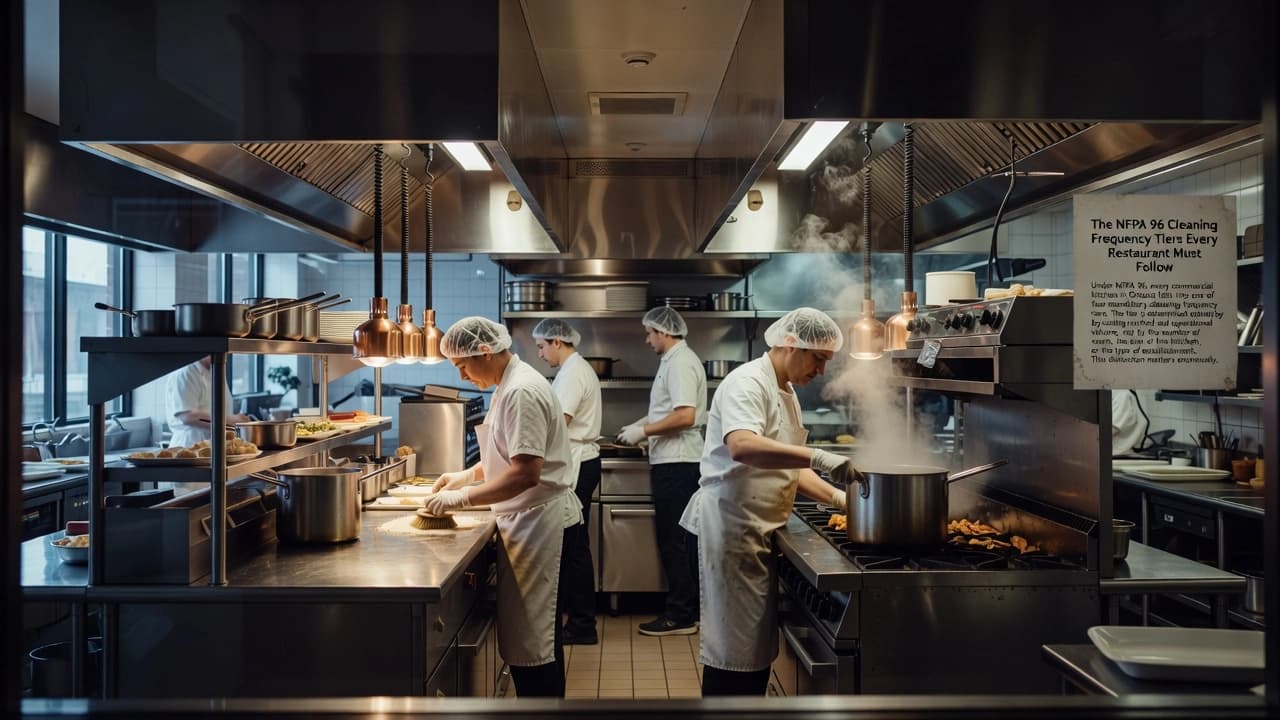
Under NFPA 96, every commercial kitchen in Ontario falls into one of four mandatory cleaning frequency tiers. The tier is determined entirely by cooking method and operational volume, not by the number of seats, the size of the kitchen, or the type of establishment. This distinction matters enormously for independent operators who assume a smaller footprint automatically means less frequent cleaning requirements.
Here is how the four tiers break down:
Monthly cleaning applies to solid fuel cooking operations such as wood-burning ovens and charcoal grills, as well as any kitchen operating around the clock. The 2025 NFPA 96 revision made 24/7 operations an explicit monthly requirement, a critical update for high-volume Toronto-area restaurants that may have previously operated on quarterly schedules.
Quarterly cleaning covers high-volume operations including heavy charbroiling, wok cooking, and intensive fryer use. These cooking methods generate grease-laden vapour at rates that make quarterly inspection the minimum defensible interval.
Semi-annually applies to moderate-volume sit-down restaurants running conventional menus during standard service hours. This is the tier most independent Ontario operators fall under, though many misidentify themselves here when their cooking method actually places them in the quarterly category.
Annually applies to low-volume or seasonal operations: day camps, churches, institutional kitchens with limited service hours.
A critical point: if any inspection reveals grease accumulation before a scheduled interval, cleaning must happen immediately regardless of the calendar. The tier schedule sets a minimum, not a ceiling.
Ontario Fire Code enforcement runs parallel to these requirements. In practice, Ontario fire inspectors reference NFPA 96 as the technical standard during compliance enforcement, making adherence non-optional for Ontario operators. A 20-seat restaurant running a high-volume charbroiler during peak service belongs in the quarterly tier regardless of its size. Cooking method and volume determine compliance obligations, full stop.
The 2025 NFPA 96 Update That Affects High-Volume Toronto Kitchens
The 2025 edition of NFPA 96 introduced a material change that directly affects how high-volume kitchens across the GTA must schedule exhaust cleaning. Under the updated standard, operations running on a continuous or 24/7 basis, including late-night diners, hotel kitchens, hospital cafeterias, and ghost kitchen facilities, are now explicitly classified under the monthly cleaning tier rather than the quarterly schedule many operators had previously followed. This reclassification is not administrative housekeeping; it reflects a fundamental reassessment of how grease accumulates in systems that never fully cool down or go dormant between service periods.
The reasoning behind the change is straightforward and supported by incident data from high-frequency operations. Kitchens running around the clock generate grease deposits at a rate that a quarterly interval cannot safely manage. Where a conventional sit-down restaurant may log 60 to 80 cooking hours between quarterly services, a 24/7 operation logs three to four times that volume. Suppression nozzles can become partially blocked, ductwork can reach ignition-threshold grease levels, and the entire exhaust pathway becomes a compounding liability. Industry leaders have publicly called for NFPA standards to better reflect these modern cooking realities, and the 2025 revision is a direct response to documented pressure from fire safety professionals and exhaust service providers.
The compliance risk for Toronto operators is immediate. Any restaurant, hotel kitchen, or ghost kitchen facility still operating on a pre-2025 vendor contract scheduled at quarterly intervals may already be out of compliance as of 2026. Contracts and internal maintenance schedules written before the revision took effect need to be reviewed and updated without delay.
Power Hoods Systems operates 24/7 with overnight scheduling built specifically for continuous-operation kitchens. Services can be completed during off-peak hours without disrupting service, ensuring monthly compliance is maintained without operational downtime.
Why Tandoor and Wok Kitchens Face the Strictest Cleaning Requirements
Not all commercial kitchens generate the same grease load, and the gap between a standard gas range and a tandoor oven or high-output wok station is significant enough that NFPA 96 treats them as separate compliance categories entirely.
The Grease Chemistry of Tandoor and Wok Cooking
Tandoor ovens operate at temperatures exceeding 480°C (900°F), with fat-heavy marinades applied directly to meats like chicken, lamb, and paneer before they enter the clay-lined chamber. At those temperatures, animal fats vaporize almost instantly, driving a dense, carbonized grease mist into the exhaust stream alongside soot particulates unique to clay-oven combustion. Standard gas range cooking produces nothing comparable in volume or composition.
Wok cooking presents a different but equally demanding challenge. Flash-frying at extreme temperatures with large oil quantities produces rapid oil vaporization, a phenomenon central to achieving "wok hei" flavor, that sends a continuous fine-particulate grease mist into the hood canopy far faster than conventional stovetop or grill cooking. The result is accelerated duct fouling that can compromise an exhaust system between scheduled service intervals.
Where These Kitchens Fall Under NFPA 96
According to NFPA 96 compliance guidance for restaurant operators, wok cooking is explicitly named in the quarterly high-volume tier, and high-temperature tandoor operations are placed at the monthly cleaning level in practice due to maximum grease-loading risk. Most active South Asian, Chinese, and fusion restaurants across Mississauga, Brampton, and Toronto operate six to seven days per week with extended service hours, placing them squarely in the most frequent cleaning categories under NFPA 96 standards. Local Ontario fire authorities routinely enforce the strictest end of that range given the cooking volumes involved.
Why Generalist Contractors Fall Short
The problem is that standard hood cleaning contractors are typically equipped and trained for moderate-output kitchens. The dense, carbonized deposits produced by tandoor and wok systems require specialized chemical formulations, extended dwell times, and access techniques designed for high-temperature grease. Contractors without this capability leave residual grease in ductwork that fails the NFPA 96 bare-metal standard, resulting in failed fire marshal inspections and unresolved fire risk between service visits.
Power Hood Systems has specialized in high-volume tandoor and wok exhaust systems throughout the GTA since 1993. With more than 5,000 completed projects across Mississauga, Brampton, and Toronto, those communities hold among the highest per-capita concentrations of these kitchen types in Canada, giving Power Hood Systems direct, field-tested expertise that generalist contractors cannot replicate.
What Certified Hood Cleaning Actually Means and What to Demand from Any Vendor
A compliant hood cleaning service delivers three non-negotiable outputs: a written report documenting all work performed across every system component, a deficiency log identifying any parts requiring repair or follow-up attention, and a signed, dated compliance certificate physically affixed to each cleaned hood. This is not a matter of preference or vendor discretion. Under NFPA 96, the complete exhaust path from hood canopy and filters through all accessible ductwork to the rooftop exhaust fan must be cleaned and documented. A vendor who cleans only visible surfaces and hands over a basic invoice has not delivered a compliant service, regardless of how thorough the physical work appeared.
That compliance certificate carries significant legal weight. Fire marshals, insurance adjusters, and loss-control investigators treat it as the primary evidence of proper maintenance when reviewing a restaurant following an incident or audit. [NFPA 96 certified hood cleaning directly protects your insurance coverage](https://kitchenguard.com/fw/why-nfpa-96-certified-hood-cleaning-protects-your-restaurant-and-insurance-coverage/) because without documented proof of compliant cleaning, operators have no defensible record when a claim or inspection arises. The certificate is the difference between a covered loss and a denied claim.
Verbal assurances and informal receipts carry no standing under NFPA 96 or Ontario Fire Code enforcement. Undocumented cleaning is treated as no cleaning at all, exposing the operator to failed inspections, fines, mandatory closure orders, and full liability in the event of fire or injury. Before hiring any vendor, ask these four questions directly:
- NFPA 96 certification status: Are the technicians IKECA-certified or equivalent?
- Documentation format: Will you receive a written report detailing all work performed?
- Deficiency reporting: Does the service include a written deficiency log?
- Commercial liability insurance: Does the company carry adequate coverage protecting your premises?
Any vendor unable to answer all four clearly should not be contracted.
Blocked Suppression Nozzles: The Hidden Fire Risk Most Restaurants Overlook
Grease-laden vapors produced during cooking do not stop at the visible hood surface. They travel the full exhaust pathway, settling into duct interiors, exhaust plenums, rooftop fans, and critically, directly onto fire suppression nozzles. When hardened grease coats a suppression nozzle's orifice, it physically obstructs the spray pattern the system relies on to blanket a fire within seconds of activation. The result is a suppression system that appears operational during routine inspection but fails to perform at the precise moment it is needed most. This is not a theoretical scenario; grease and grime buildup on nozzles is a documented inspection failure point in commercial kitchen fire safety audits, and confirming nozzle orifices are unobstructed is a distinct, mandatory component of any compliant suppression system inspection.
The scale of this risk is significant. Cooking equipment causes approximately 60% of all restaurant fires, with grease accumulation in hoods and ducts appearing as a consistent contributing factor across incident data. When suppression systems cannot discharge correctly because nozzles are blocked, fire damage compounds rapidly. The automatic response that should contain a blaze within seconds is delayed or neutralized, and what begins as a contained equipment fire extends to adjacent surfaces, ductwork, and structure. According to a 2026 commercial kitchen fire safety analysis, grease buildup in hood filters, ductwork, and related components can simultaneously ignite a fire and compromise the system designed to suppress it, making the combination especially dangerous for high-volume operations.
A common and costly misconception is that a clean-looking hood surface equals a compliant kitchen. Hood-surface-only cleaning services leave ductwork interiors and rooftop exhaust fans completely unaddressed, and these are precisely the zones where the most dangerous grease concentrations accumulate in high-volume kitchens. Visible cleanliness does not equal fire safety compliance. NFPA 96 mandates thorough cleaning of the full exhaust system from hood to fan, not just accessible front surfaces. Operators who accept hood-only service quotes receive a false appearance of compliance while the most flammable grease deposits remain in place.
The 2026 industry trend toward inspecting hidden system components rather than visible surfaces reflects a direct response to this gap. Referred to broadly as the "Clean Slate" movement within the commercial kitchen safety sector, this shift emphasizes ductwork interiors, rooftop fan housings, and suppression nozzle condition as primary inspection targets rather than afterthoughts. For restaurant operators, the practical implication is straightforward: require any vendor to document full duct-to-fan cleaning as a named line item in their service quote, and separately confirm that suppression system inspections explicitly verify nozzle condition and spray pattern integrity. A quote that references only hood cleaning is not a full-system service, regardless of how it is priced or described.
What Happens If Your Restaurant Fails a Fire Inspection
A failed hood or exhaust inspection in Ontario follows a predictable escalation path. A fire prevention officer issues a written order citing each deficiency and setting a correction deadline. For routine violations, that window typically runs 30 to 90 days. For serious life-safety concerns, the timeline collapses to 24 to 72 hours. Where an imminent hazard exists, there is no correction window at all; the kitchen is ordered shut on the spot and stays closed until a follow-up inspection confirms the deficiency is resolved. Non-compliance beyond the deadline can trigger daily fines and, in severe cases, complete operational closure. A secondary risk that operators frequently underestimate is insurance exposure: if a fire occurs after a failed inspection, insurers can deny the claim entirely, leaving the owner absorbing full repair and liability costs.
NFPA 96 Section 11.6.1 adds a critical layer that calendar-based cleaning schedules do not address. The condition-based override requires cleaning before the next cooking period if any grease deposits are found during inspection, regardless of when the last scheduled service occurred. A kitchen cleaned 30 days ago is not protected if grease has visibly re-accumulated. This provision overrides scheduled intervals entirely and is one of the most frequently misunderstood compliance requirements operators face.
A proper remediation response moves quickly and follows a documented sequence: contact a certified cleaning contractor immediately, complete expedited full-system cleaning with timestamped before-and-after documentation, obtain a signed compliance certificate, submit proof to the fire prevention officer, and schedule re-inspection before the deadline. Maintenance records must be updated to reflect the corrected service interval going forward.
Power Hoods Systems operates 24/7 emergency service built precisely for this scenario. With the capacity to mobilize overnight crews across Ontario, including Toronto, Mississauga, Hamilton, and Ottawa, the team can complete full certified cleaning with proper documentation and enable re-inspection scheduling before the next day's service opens.
How Hood Cleaning Non-Compliance Can Void Your Restaurant Insurance
Most commercial property and general liability insurance policies for restaurants contain explicit maintenance clauses that make NFPA 96 compliance, or equivalent local fire code compliance, a condition of coverage. These clauses are not buried in fine print. They establish that operators bear ongoing responsibility for documented, certified maintenance of fire-risk systems, including kitchen exhaust equipment. Failing to meet that obligation gives insurers a contractual basis to contest or deny any claim arising from a fire.
The real-world consequence of non-compliance is severe. When a grease fire occurs, fire investigators and insurance adjusters examine the exhaust system immediately. If they determine that hood cleaning was overdue, performed outside the required schedule, or carried out by uncertified technicians, the insurer can deny the claim entirely. That denial leaves the restaurant operator personally liable for property damage, business interruption losses, and any third-party injuries sustained on the premises. No coverage means no rebuilding assistance, no revenue replacement, and no protection against lawsuits from injured guests or employees.
The exposure does not begin only after a fire. Insurance underwriters are increasingly requesting cleaning certificates during policy renewals as standard practice. Documentation gaps, such as missing service records, certificates signed by uncertified contractors, or intervals that exceed NFPA 96 requirements, are now flagged as risk factors. Operators with incomplete records face higher premiums or outright coverage refusals before any incident has occurred.
Framing certified hood cleaning as a financial protection strategy, not just a regulatory obligation, changes how operators should evaluate the cost. A single denied fire claim exposes a restaurant to losses that can reach hundreds of thousands of dollars in property damage alone, plus business interruption and liability exposure. Regular certified cleaning, priced as a recurring operational expense, represents a fraction of that deductible exposure. Maintaining a complete, uninterrupted documentation record is one of the most cost-effective risk management decisions a restaurant operator can make.
How to Stay Compliant Without Shutting Down for a Night of Service
The most common reason Ontario restaurant operators delay hood cleaning has nothing to do with doubting its importance. It comes down to a straightforward revenue calculation: the assumption that a full-system cleaning requires shutting the kitchen down during service hours, costing covers, staff hours, and nightly revenue. That assumption is incorrect, and acting on it exposes a restaurant to risks that cost far more than a lost dinner service.
Professional hood cleaning contractors with overnight scheduling capability complete the full duct-to-fan cleaning scope between a restaurant's closing time and the following morning's prep window. There is no service disruption, no lost revenue, and no trade-off between compliance and operations. A restaurant closing at midnight can have a fully cleaned, NFPA 96-certified exhaust system with documentation ready before the 7 a.m. prep crew arrives. Average cleaning duration runs 2 to 4 hours per system, meaning even a moderately complex kitchen fits comfortably inside a standard overnight window.
In practice, an overnight engagement requires straightforward access: kitchen entry after last service, protective sheeting over adjacent equipment, and a designated water disposal point. The crew applies chemical degreaser to the heaviest buildup areas, pressure washes the full system from hood filters through ductwork to the rooftop exhaust fan, contains and removes all wash water, then dries and finishes all stainless surfaces. When staff arrive in the morning, they find a clean, dry kitchen with a dated certification sticker on the hood and a written compliance report ready for any fire inspector.
Power Hoods Systems operates on exactly this model. With 24/7 availability across the GTA and Ontario, including Toronto, Mississauga, Brampton, Hamilton, and Ottawa, compliance cleaning is scheduled around service hours. No operator needs to choose between a compliant kitchen and a full night of revenue.
Managing Hood Cleaning Compliance Across Multiple GTA Locations
For restaurant groups, franchises, and ghost kitchen operators running multiple GTA locations, hood cleaning compliance is not a single obligation. It is a matrix of independent requirements. Each kitchen carries its own NFPA 96 cleaning frequency tier based on cooking type, equipment, and daily operating hours. A single operator might simultaneously run a downtown Toronto ghost kitchen on a monthly cleaning schedule, a Mississauga casual dining location on a quarterly schedule, and a Brampton corporate cafeteria requiring only semi-annual service. Tracking, scheduling, and documenting each location independently, especially across multiple vendors, creates significant administrative exposure and a high probability of gaps during multi-site fire inspections.
Consolidating this under a single certified vendor resolves the fragmentation problem directly. When one provider manages all locations, documentation follows a consistent format across every service visit, certificates are issued uniformly for each hood cleaned, and deficiency logs are maintained in a standardized way that surveyors can review without reconciling conflicting paperwork from multiple contractors. For operators facing portfolio-level compliance reviews, that consistency is not a minor convenience; it is the difference between a clean inspection and a cascade of reinspection orders across otherwise compliant properties.
Ghost kitchens warrant particular attention in this context. High-volume by design, frequently operating continuously, and often hosting multiple virtual brands out of a single kitchen, they are precisely the operations that fall into the monthly cleaning category under the 2025 NFPA 96 revision. That means up to 12 service coordination events per location per year, a volume that demands a proactive vendor relationship rather than reactive scheduling.
Power Hoods Systems serves restaurant groups, franchises, and ghost kitchen operators across Toronto, Mississauga, Hamilton, Ottawa, and Brampton as a single-vendor solution, delivering consistent NFPA 96-compliant certification documentation across an operator's entire Ontario portfolio.
The Real Fire Risk Numbers Ontario Restaurant Operators Should Know
The scale of the risk facing Ontario restaurant operators is not abstract. Approximately 15,000 restaurant fires occur annually across the United States, with cooking equipment identified as the cause in roughly 60% of incidents. Canadian fire patterns follow the same trajectory, making US benchmark data directly relevant for operators across Toronto, Mississauga, Hamilton, and the broader Ontario market.
Grease accumulation in exhaust systems sits at the center of that risk profile. Approximately 22% of restaurant fires are attributed directly to grease buildup in hoods and exhaust systems. The IKECA Journal pushes that figure higher, estimating that nearly one-third of all restaurant fires involve grease accumulation when hidden ductwork and rooftop exhaust components are factored into the analysis. These are not fringe incidents tied to aging equipment or unusual cooking styles. They occur across ordinary operations that simply fell behind on scheduled maintenance.
What makes these numbers significant is their preventability. Equipment failures and electrical faults carry an inherent unpredictability. Grease accumulation does not. It follows a measurable, foreseeable cycle determined by cooking volume, fuel type, and elapsed time since the last certified cleaning. Every grease fire that originates in a kitchen exhaust system represents a maintenance schedule that was not followed, making it a compliance failure rather than an unavoidable accident.
The financial consequences compound that failure quickly. A restaurant fire triggers a closure period that typically extends from several weeks to several months, depending on damage scope and inspection requirements before reopening. Staff layoffs follow, often permanently for part-time employees. Some operations never reopen at all. As covered in the previous section, insurers treat NFPA 96 non-compliance as grounds to contest or void claims entirely, converting a preventable maintenance gap into a total financial exposure event.
Protecting Your Restaurant Starts With the Right Cleaning Schedule
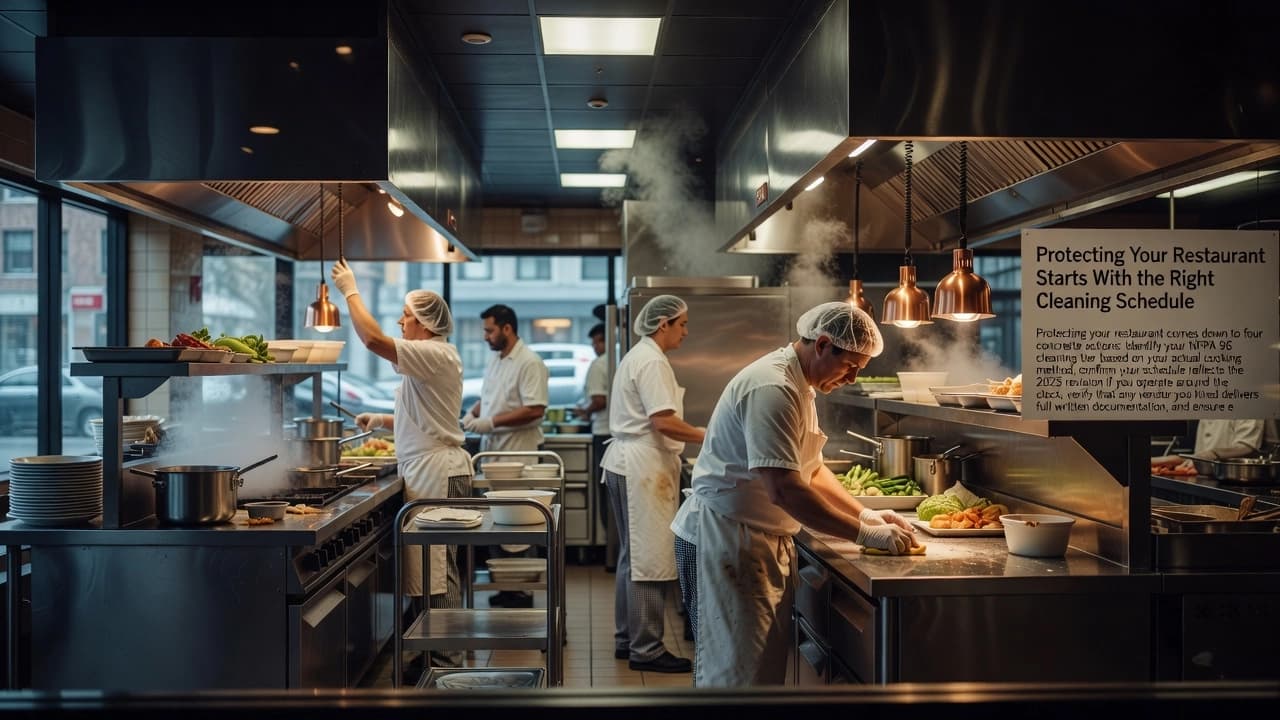
Protecting your restaurant comes down to four concrete actions: identify your NFPA 96 cleaning tier based on your actual cooking method, confirm your schedule reflects the 2025 revision if you operate around the clock, verify that any vendor you hire delivers full written documentation, and ensure every cleaning engagement covers the complete system from the hood canopy to the rooftop exhaust fan. These are not optional best practices. Ontario fire inspectors enforce NFPA 96 as a technical standard, and the consequences of non-compliance are direct: written orders, reinspection fees, mandatory closure, and insurance claims denied because maintenance records could not be produced following a fire. Grease accumulation contributes to roughly 22% of all restaurant fires, and every one of those incidents carries a paper trail that insurers and fire investigators will examine closely.
Power Hoods Systems has served Ontario restaurants since 1993, completing more than 5,000 projects across Toronto, Mississauga, Hamilton, Ottawa, and Brampton. With NFPA 96-certified technicians and overnight scheduling designed to work around your service hours, compliance does not have to cost you a night of revenue.
Contact Power Hoods Systems today to book a compliance assessment or schedule a cleaning that fits your operation.
Conclusion
Keeping your commercial kitchen hood clean is not just a box to check. It is a legal obligation, a safety necessity, and a direct investment in the long-term success of your restaurant.
To recap the essentials: cleaning frequency is determined by your cooking volume and fuel type; only certified technicians can perform compliant cleanings; proper documentation protects you during inspections; and neglecting your hood system puts your staff, guests, and business at serious risk.
Do not wait for a failed inspection or, worse, a fire to take action. Review your current cleaning schedule, verify your contractor's certifications, and ensure your records are up to date.
Your restaurant represents years of hard work. Protect it with a proactive approach to hood maintenance, and you will operate with greater confidence, compliance, and peace of mind every single day.